By the MoneyForge Editorial Team | Updated November 2026 | 10 min read
When you drive for Uber, deliver for DoorDash, freelance as a designer, or juggle three client contracts, nobody hands you a benefits packet. There’s no HR department, no automatic payroll deduction, and no employer match waiting in the wings. Retirement saving is entirely on you.
That freedom comes with a catch, and it also comes with an opportunity. Because you’re self-employed, you can access some of the most powerful retirement accounts in the tax code, including options that many traditional employees can’t use. The real question is which account fits your income, your tax situation, and your goals.
This guide compares the Roth IRA with the 401(k) options available to gig workers and freelancers in 2026, explains who each one suits best, and gives you a simple framework for deciding. If your income is irregular, you’re not behind, and you’re not too late. You just need a plan built for how you actually earn.
First, a Quick Reality Check About “401(k)” for Freelancers
If you’re self-employed with no employees, you generally can’t join a company 401(k), because you don’t have a company. What you can open is a Solo 401(k), sometimes called an individual 401(k). It works much like a regular 401(k), but it’s designed for business owners with no employees other than a spouse.
If you have a part-time W-2 job that offers a workplace 401(k) alongside your gig income, you may have access to both. That’s a common setup, and it creates some interesting strategy, which we’ll cover below.
For most pure freelancers and gig workers, the real comparison is between a Roth IRA and a Solo 401(k), with the SEP IRA as a close third option.
How a Roth IRA Works
A Roth IRA is an individual retirement account you fund with money you’ve already paid income tax on. In exchange, your investments grow tax-free, and qualified withdrawals in retirement are also tax-free.
Key features for 2026:
- Contribution limit: $7,500 for most people, with an extra $1,100 catch-up contribution if you’re 50 or older. Limits are adjusted periodically, so confirm current figures on IRS.gov.
- Income limits: Eligibility to contribute phases out at higher incomes. For 2026, the phase-out begins around $153,000 for single filers and around $242,000 for married couples filing jointly, based on modified adjusted gross income.
- Flexibility: You can withdraw your contributions (not earnings) at any time without taxes or penalties. That makes a Roth IRA a useful backup if your income swings.
- No required minimum distributions during your lifetime.
- Open anywhere: Brokerages like Fidelity, Charles Schwab, and Vanguard offer Roth IRAs with no minimum balance and low or zero fees.
- Deadline: You can contribute for a given tax year until the tax filing deadline the following April, which suits freelancers who don’t know their income until the year is over.
How a Solo 401(k) Works
A Solo 401(k) lets you contribute in two roles: as the “employee” and as the “employer.” That double role is what makes it so powerful.
Key features for 2026:
- Employee deferrals: Up to $24,500 for the year, with an additional catch-up contribution if you’re 50 or older (and an even higher catch-up for ages 60 to 63 under current rules).
- Employer contributions: On top of your deferrals, you can contribute a percentage of your net self-employment income as the “employer.” Combined, the total limit is around $72,000 for 2026, excluding catch-up amounts.
- Roth or traditional: Many providers let you choose pre-tax (traditional) contributions, Roth contributions, or a mix. Not every provider offers a Roth option, so check before you open one.
- Loans: Some Solo 401(k) plans allow you to borrow from your balance, which an IRA doesn’t.
- Setup deadlines: To make employee deferrals for a given year, you generally need to have the plan established by the end of that year. Employer contributions can often be made up to your tax filing deadline.
- Paperwork: Once your plan balance passes $250,000, you generally must file an annual Form 5500-EZ with the IRS. Below that, you typically don’t.
Roth IRA vs Solo 401(k): Side-by-Side
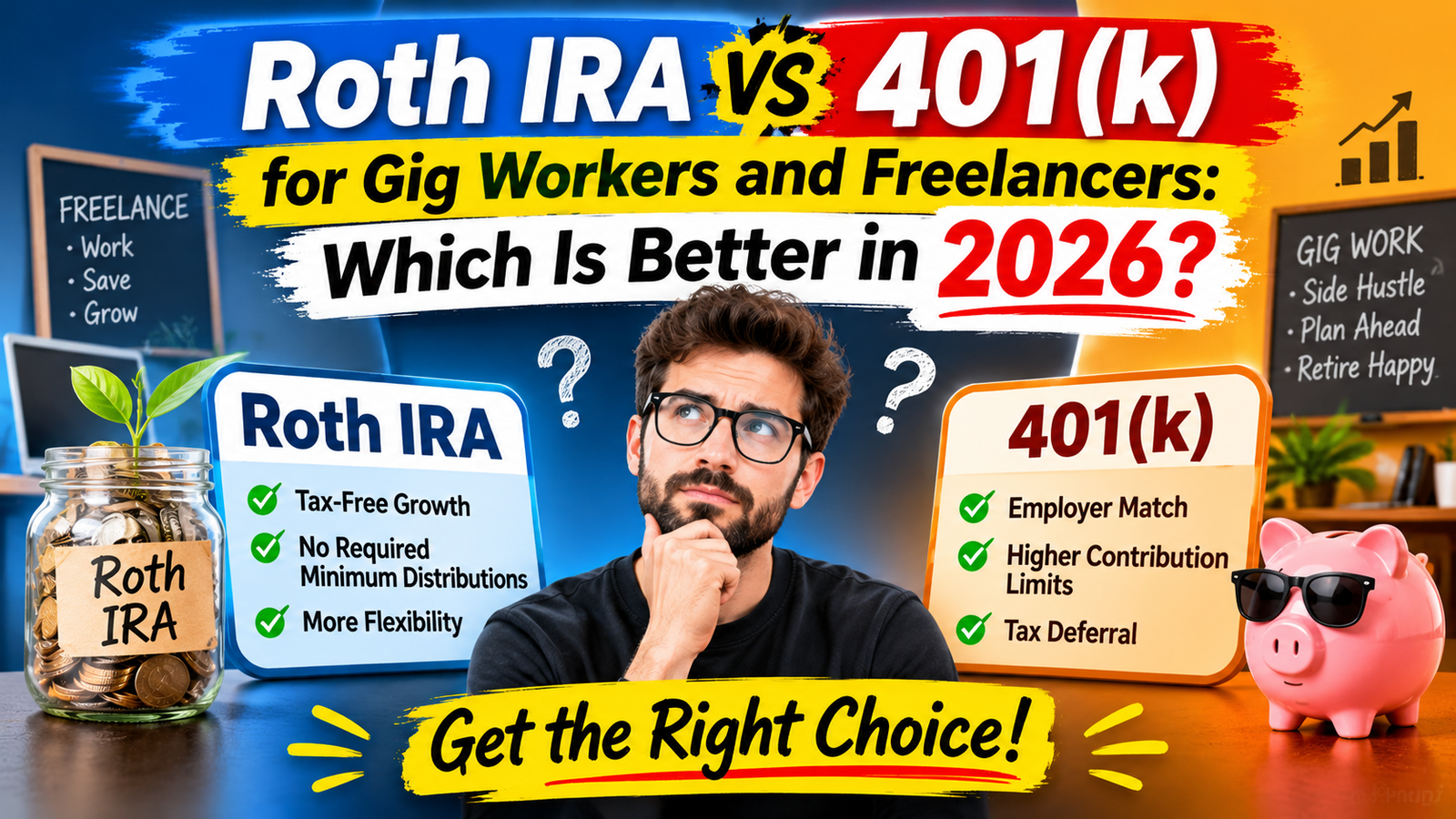
| Feature | Roth IRA | Solo 401(k) |
|---|---|---|
| 2026 base contribution limit | $7,500 | $24,500 employee deferral plus employer contribution (about $72,000 combined) |
| Tax treatment | After-tax contributions, tax-free growth and withdrawals | Traditional (tax deduction now) or Roth (tax-free later), depending on the plan |
| Income limit to contribute | Yes, phases out at higher incomes | No income limit |
| Who qualifies | Anyone with earned income below the limits | Self-employed with no employees (spouse allowed) |
| Access to contributions | Contributions can be withdrawn anytime | Early withdrawals generally penalized; loans may be allowed |
| Setup complexity | Very simple | Moderate, with some paperwork |
| Best for | Lower or variable income, flexibility | Higher income, maximizing savings |
Why This Decision Matters More for Gig Workers
Taxes are the hidden factor that changes the math for self-employed people.
As a freelancer, you pay self-employment tax of 15.3% on your net earnings (covering Social Security and Medicare), in addition to regular income tax. That’s a heavy load, and it makes every dollar of tax savings more valuable.
A traditional (pre-tax) Solo 401(k) contribution reduces your taxable income, which can lower your federal income tax bill meaningfully. A Roth IRA doesn’t give you a deduction today, but it protects you from higher taxes later.
Both have strengths. The right pick depends on a few personal factors.
Which Is Better? It Depends on These Four Questions
1. How much can you actually afford to save?
If you’re realistically saving $300 to $600 a month, a Roth IRA’s $7,500 annual limit is plenty. You don’t need a Solo 401(k) just because it allows more. A simple account you actually fund beats a sophisticated one you ignore.
If you’re a higher earner who can save $2,000 or more a month, the Roth IRA’s cap will run out fast. A Solo 401(k) lets you put away far more and capture bigger tax benefits.
2. Is your income steady or unpredictable?
Irregular income is the defining feature of gig work. One month you earn $6,000, the next $2,200.
A Roth IRA shines here. There’s no required monthly contribution, and you can deposit whenever cash is available, up until the April deadline. The ability to withdraw contributions without penalty also acts as a secondary safety net.
A Solo 401(k) can work too, since you decide how much to contribute and when. But the employee deferral is tied to the year’s earnings, and early withdrawals of any kind are generally penalized.
3. What tax bracket are you in now versus later?
The classic rule of thumb: if you expect to be in a higher tax bracket in retirement, Roth contributions make sense. If you’re in a high bracket now and expect a lower one later, pre-tax contributions are attractive.
Many gig workers early in their careers or in a lower-income year fall into lower brackets, which favors Roth. Established freelancers with high net income often benefit from the deduction a traditional Solo 401(k) provides.
An extra consideration: the qualified business income (QBI) deduction can lower your taxable income if you’re a pass-through business owner. Reducing your income with pre-tax contributions interacts with that deduction, so this is worth running through with a tax professional.
4. Do you want simplicity or maximum power?
A Roth IRA takes about 15 minutes to open online. A Solo 401(k) requires choosing a provider, getting an Employer Identification Number (EIN) in many cases, and keeping track of contribution rules.
Providers like Fidelity, Schwab, and E*TRADE offer Solo 401(k) accounts with straightforward setup and no or low fees, but it’s still more involved than an IRA.
What About the SEP IRA?
The SEP IRA is a simpler cousin of the Solo 401(k). You contribute as the “employer,” typically up to about 25% of your net self-employment income (after a small adjustment), with a dollar cap of around $72,000 for 2026.
Its big advantages are easy setup and high limits. Its downsides: there’s generally no employee deferral component, which means lower-income freelancers can contribute less than they could into a Solo 401(k), and Roth treatment options are more limited. For most freelancers earning modest incomes, a Solo 401(k) allows higher contributions at the same earnings level. For higher earners who value simplicity, a SEP IRA is a solid option.
The Best Strategy for Many Gig Workers: Use Both
You don’t have to pick only one. A common, powerful approach looks like this:
- Build a small emergency fund first. If you don’t have at least one month of expenses saved, start there. Gig income can disappear quickly.
- Capture any employer match. If you have a part-time W-2 job with a 401(k) match, contribute enough to get the full match. It’s essentially an instant return on your money.
- Fund a Roth IRA up to the annual limit while your income is in the Roth-eligible range.
- Use a Solo 401(k) for the overflow. Once you’ve maxed your Roth IRA and still have savings capacity, add a Solo 401(k) to shelter additional income.
This “waterfall” gives you tax diversification, meaning some money grows tax-free, and some is deducted now. That flexibility helps you manage taxes in retirement.
A Few Examples
Maria, rideshare driver, $38,000 net income. She struggles to save more than $350 a month. A Roth IRA is the best fit: it’s simple, flexible, and her current tax bracket is low. She may also qualify for the Saver’s Credit, a federal tax credit that rewards lower-income savers for retirement contributions.
Daniel, freelance software developer, $140,000 net income. He wants to reduce his tax bill and save aggressively. A Solo 401(k) with traditional contributions provides large deductions, and he may add a Roth IRA if his income stays below the phase-out range.
Priya, part-time employee plus weekend photographer. She has a workplace 401(k) with a match. She captures the match, funds a Roth IRA, and later considers a Solo 401(k) for her photography income as it grows. Note that employee deferral limits apply across all of your 401(k) plans combined, not per plan.
Mistakes Gig Workers Commonly Make
- Waiting until income is “stable.” Irregular income is exactly why you should start small now. Even $50 a month matters over time.
- Skipping the tax set-aside. Money for quarterly estimated taxes isn’t available for retirement. Set aside a share of every payment for taxes first, often 25% to 30%, then save for retirement from what’s left.
- Choosing the account for the biggest limit rather than the best fit. A bigger account you can’t fund is useless.
- Missing the Solo 401(k) setup deadline. If you want to make employee deferrals for 2026, don’t wait until the following spring to open the account.
- Cashing out early. Early withdrawals from retirement accounts can trigger taxes and a 10% penalty, with limited exceptions.
- Forgetting to invest the money. Contributing to an account isn’t the same as investing it. Choose low-cost index funds or target-date funds so your contributions actually grow.
A Simple Decision Guide
- Income under about $50,000 net or very irregular: Start with a Roth IRA.
- Steady income and want to save more than $7,500 a year: Add a Solo 401(k).
- High income above the Roth limits: Use a Solo 401(k) as your main account.
- Not sure about your tax bracket: Split between Roth and traditional contributions.
- Want the easiest possible setup: Roth IRA or SEP IRA.
Final Thoughts
For most gig workers and freelancers, the answer to “Roth IRA or 401(k)?” isn’t an either-or decision. The Roth IRA is the best starting point for its simplicity, flexibility, and tax-free growth. The Solo 401(k) becomes the right tool as your income grows and you want to save, and deduct, more.
The most important step is the first one. Open an account this month, make a small contribution, and set a reminder to add more whenever a big payment lands. Over decades, steady contributions and compounding matter far more than finding the perfect account on day one.
Disclaimer: This article is for general educational and informational purposes only and does not constitute financial, tax, or legal advice. Contribution limits, income thresholds, and tax rules change and depend on your individual situation. Verify current figures with the IRS (irs.gov) and consider consulting a qualified tax professional or financial advisor before making decisions.
Sources and further reading: IRS Retirement Topics and Publication 560 (Retirement Plans for Small Business); IRS annual retirement plan limits announcements; Consumer Financial Protection Bureau (consumerfinance.gov).