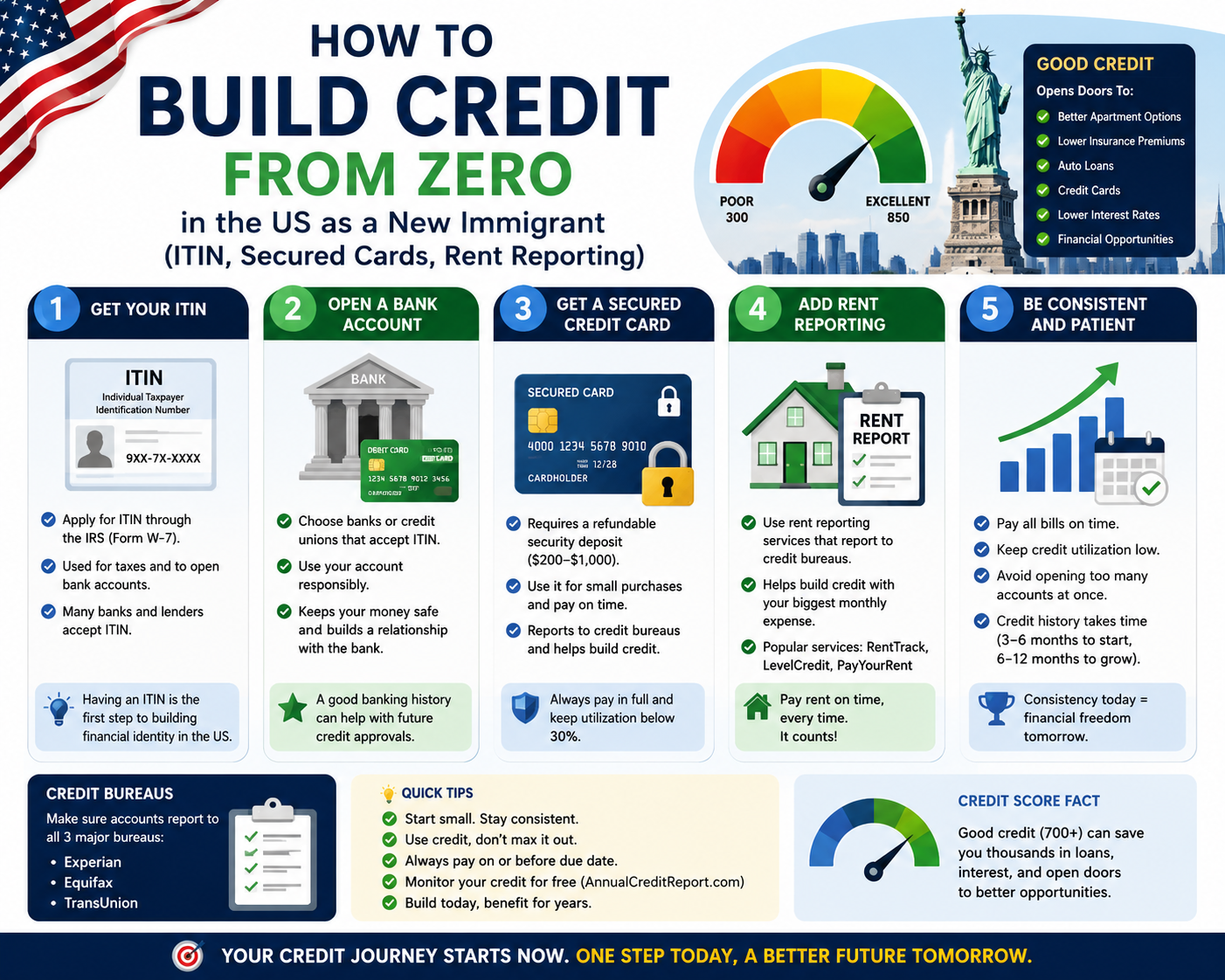
Meta description: New to the US with no credit history? Here’s a step-by-step plan to build a credit score using an ITIN or SSN, secured cards, credit-builder loans, and rent reporting.
Moving to the United States often means starting your financial life over. You may have had an excellent credit record back home, but in the US your score is effectively zero. That “credit invisibility” can lead to a rejected apartment application, a denied phone plan, or a car loan with a painful interest rate.
The good news is that US credit is a system, and systems can be learned. This guide walks you through each step: getting the right ID number, opening your first accounts, using rent and bills to your advantage, and avoiding the scams that target newcomers.
First, Understand How US Credit Works
Your credit report is a record of how you’ve used credit, kept by the three main bureaus: Experian, Equifax, and TransUnion. Your credit score is a number calculated from that report. Lenders, landlords, insurers, and sometimes employers use it to judge risk.
The widely used FICO model weighs five factors:
- Payment history (35%): Do you pay on time?
- Amounts owed (30%): How much of your available credit are you using?
- Length of credit history (15%): How old are your accounts?
- New credit (10%): How many recent applications have you made?
- Credit mix (10%): Do you have different types of accounts?
You can learn more from myFICO and the Consumer Financial Protection Bureau (CFPB).
Two takeaways matter most for newcomers. Paying on time is the biggest factor, and time itself is a factor you can’t rush. The earlier you open your first account, the sooner your history starts aging.
Also note that to generate a FICO score you generally need at least one account that has been open for six months and has reported to the bureaus recently. Until then, you may simply see “no score,” which is normal and not a sign that something is wrong.
Step 1: Get an SSN or an ITIN
Most US lenders need a tax identification number to match your applications to your credit file.
Social Security Number (SSN)
If you are authorized to work in the US, you can apply for an SSN through the Social Security Administration. An SSN is also the number most widely accepted for credit applications.
Individual Taxpayer Identification Number (ITIN)
If you aren’t eligible for an SSN but have US tax obligations (for example, as a spouse or dependent of a visa holder, or someone with income that must be reported), you can apply for an ITIN from the IRS using Form W-7. The IRS explains the process on its ITIN page.
Some key facts about ITINs:
- An ITIN is for tax purposes only. It does not authorize you to work and does not change your immigration status.
- An ITIN that isn’t used on a federal tax return for three consecutive years can expire, so keep yours active.
- Some banks, credit unions, and fintech lenders accept ITINs for accounts and cards, though plenty of mainstream issuers still require an SSN. Always check the application requirements before applying, so you don’t take a pointless hard inquiry.
You can use an IRS-authorized Certified Acceptance Agent to help with the W-7 process; the IRS keeps a list on its website.
Step 2: Open a Bank Account
A checking or savings account doesn’t directly build your credit score, but it’s the base layer for everything else. It lets you pay rent, receive your paycheck, fund a secured card, and show a bank record.
Many banks accept a passport plus an ITIN or SSN. Credit unions are also worth a look, and many are friendlier to newcomers and members with thin files. The National Credit Union Administration’s MyCreditUnion.gov helps you find one.
Check that any account is insured by the FDIC (BankFind) or NCUA before you deposit money.
Step 3: Check Whether Your Home-Country Credit Can Travel With You
Before you start from scratch, find out if you can bring your history along.
Nova Credit is a service that translates credit reports from certain countries into a US-style format that some lenders and landlords accept. Coverage includes countries such as India, Canada, the UK, Mexico, Australia, and Brazil, but the list changes, and not every lender uses it. Check the site to see whether your country is supported.
American Express has offered a program for newcomers with existing foreign credit history, sometimes called Global Transfer. See the American Express website for current eligibility. If you qualify, it can be the fastest way to a regular, unsecured card.
If your country isn’t covered, move on to the next step. Starting from zero is common and entirely workable.
Step 4: Get a Secured Credit Card
For most newcomers, a secured credit card is the best first product. You give the issuer a refundable security deposit, often $200 to $500, and that deposit usually becomes your credit limit. The issuer then reports your payments to the bureaus just like any other card.
Typical pricing is a reminder to pay in full: one recent industry summary put the average APR on secured cards in early 2026 at about 26%, higher than rewards cards. If you pay your balance in full each month, you never pay that interest.
Names that often come up for newcomers include:
- Discover it Secured
- Capital One Platinum Secured
- Self Visa, a credit-builder-linked secured card
- Chime Credit Builder, a no-credit-check option tied to a Chime account
- Secured cards from local credit unions
Eligibility, deposits, fees, and ITIN acceptance vary by issuer and change often. Always read the current terms on the issuer’s site before applying.
What to look for
- Reports to all three bureaus. Without this, the card won’t help much.
- No or low annual fee. Don’t pay a big fee for a basic card.
- A path to upgrade. Many issuers review accounts after several months of on-time payments and return your deposit when you move to an unsecured card.
- Whether the issuer accepts your ID number (SSN or ITIN).
How to use it well
- Put one small, regular expense on it, such as a streaming service or gas.
- Set up autopay for the full statement balance so you never miss a due date.
- Keep your balance below 30% of your limit, and under 10% if you can. On a $300 limit, that’s about $30 to $90 in use at statement time.
- Don’t carry a balance to “build” credit. That’s a myth. You build credit by paying on time, not by paying interest.
Step 5: Add a Credit-Builder Loan
A credit-builder loan works in reverse: instead of receiving the money upfront, you make monthly payments into a locked account, and you get the funds at the end. Each payment is reported, creating a record of on-time installment payments, which adds variety to your credit mix.
You can get these from many credit unions and from companies like Self. Check the fees and interest, and make sure the lender reports to all three bureaus.
For a deeper explanation, see the CFPB’s guidance on credit-builder loans.
Step 6: Make Your Rent and Bills Count
If you pay rent on time every month but it never shows up on your credit report, you’re missing out. In the US, rent isn’t automatically reported. Here are some ways to change that:
- Rent-reporting services. Some landlords or property managers enroll in reporting programs. Ask your landlord whether they report to the bureaus.
- Apps that report rent for you. Services such as Bilt and others offer rent-reporting features. Check whether the service reports to all bureaus, whether it costs money, and whether the credit scoring models your lenders use will actually count it.
- Experian Boost. Experian Boost lets you add certain on-time utility, phone, and streaming payments to your Experian file. It only affects Experian-based scores, so results vary.
A word of caution: rent reporting helps most when you have a thin file, and not every lender’s scoring model counts it. Treat it as a bonus on top of a secured card, not a replacement for one.
Step 7: Consider Becoming an Authorized User
If a trusted family member or friend with a long, clean credit history adds you as an authorized user on their card, that account’s history may appear on your credit report. It can give your file a quick boost.
But be careful: if the primary cardholder runs up balances or pays late, it can hurt you too. Only do this with someone you trust, and confirm that the issuer reports authorized users to the bureaus.
Step 8: Monitor Your Credit Reports
You are entitled to free credit reports. Visit AnnualCreditReport.com, the only official site authorized by federal law, to see your reports from all three bureaus. Check for:
- Accounts you didn’t open
- Misspelled names or wrong addresses (a common problem for people with non-English names)
- Incorrect payment statuses
If you find an error, you can dispute it with the bureau. The CFPB explains how in its credit report dispute guide. Many card issuers and banks also give you free score tracking.
A Realistic Timeline
Everyone’s path is different, but here’s a general idea:
| Timeframe | What’s happening |
|---|---|
| Month 0 | Get SSN/ITIN, open bank account, apply for a secured card |
| Months 1 to 3 | Use the card lightly, pay in full, set autopay |
| Months 3 to 6 | First credit score may appear |
| Months 6 to 12 | Score builds with on-time payments; possibly add a credit-builder loan |
| Months 12 to 18 | Many people qualify to upgrade to an unsecured card or get a better rate |
Some websites promise faster miracle results. Be skeptical. Careful, steady habits will carry you further.
Common Mistakes to Avoid
- Applying for many cards at once. Each application can create a hard inquiry and lower your score slightly.
- Maxing out your card. High utilization is one of the fastest ways to hurt a new score.
- Missing a payment. A late payment can stay on your report for years, so use autopay.
- Closing your oldest account. It shortens your credit history. Keep it open if it has no annual fee.
- Paying for “guaranteed” credit fixes. See the next section.
Beware of Scams Aimed at Newcomers
Immigrants are a frequent target of credit scams. Watch for:
- Credit repair companies that promise to “erase” accurate negative information. They can’t do that legally.
- “Credit Privacy Numbers” (CPNs). Some sellers claim you can use a new nine-digit number in place of your SSN. This is illegal and can lead to fraud charges. The FTC warns about this.
- Upfront fees for credit-building help. Under federal rules, credit repair organizations generally can’t charge before they’ve performed services.
- Fake immigration or “government” agents who ask for money plus your personal data.
If you suspect fraud, report it at ReportFraud.ftc.gov and consider contacting your state attorney general. Legitimate nonprofit credit counselors can be found through the CFPB and its list of resources.
What About Big Purchases?
Once your score is established, you can start thinking about larger goals:
- Renting an apartment. Some landlords accept a larger deposit or a co-signer if your score is low. Nova Credit reports are also accepted by some landlords.
- Car loans. Compare offers from credit unions and banks, and keep shopping within a short window so multiple inquiries count as one.
- Mortgages. Some lenders offer ITIN mortgage programs. Rates and requirements differ by lender, so compare carefully, and see the CFPB’s homebuying tools.
Frequently Asked Questions
Can I build credit with just an ITIN?
Yes, with lenders that accept it. Options include certain credit unions, some secured cards, and credit-builder loans. Acceptance varies by lender, so check requirements first.
Do I need a Social Security Number to get a credit score?
No. Credit files can be built using an ITIN, although having an SSN gives you access to more products.
Does my credit score from my home country transfer?
Not automatically. Services like Nova Credit can translate reports from certain countries for participating lenders.
How long does it take to build good credit?
You can see a first score in about six months and a solid one within roughly one to two years of consistent on-time payments.
Does checking my own credit hurt my score?
No. Checking your own report is a “soft inquiry” and has no effect.
Is a debit card good for building credit?
No. Debit cards don’t report to the credit bureaus.
Final Thoughts
Building credit in the US as a newcomer comes down to a short list of habits: get your ID number, open a bank account, add one or two credit-building tools, pay on time every month, keep balances low, and give it time. Skip the shortcuts and the people who sell them.
The score you build over the next year or two will follow you through apartment applications, car loans, and eventually a home. It’s slower than you’d like, but it works.
Disclaimer: This article is for general informational purposes only and isn’t financial, legal, or immigration advice. Products, fees, and eligibility rules change. Check each lender’s current terms and consult a qualified professional for your situation.